The South African OCR World Champion will face 600 monkey bars suspended beneath Bloukrans
Bridge, 216 metres above the gorge, during a weather window between October 26-27, 2026.
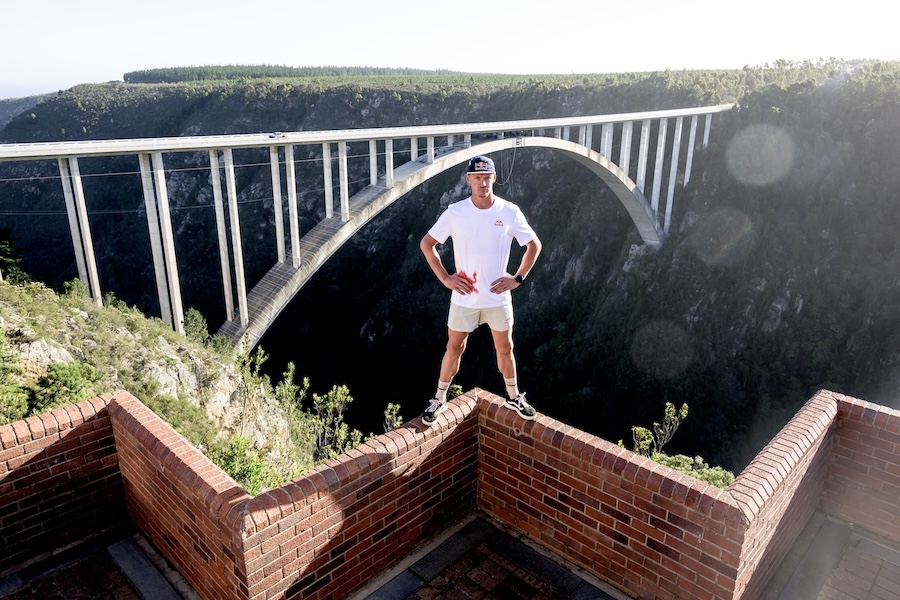
BLOUKRANS BRIDGE, SOUTH AFRICA – 20 October 2026: Red Bull athlete Thomas van Tonder (South Africa) is preparing to become the first person to cross 600 monkey bars suspended beneath a bridge, taking on a course that follows the curved arch of Bloukrans Bridge in South Africa’s Eastern Cape. The attempt is scheduled within a weather window between 26 and 27 October 2026, with van Tonder set to traverse approximately 280 metres by hand, around 216 metres above the Bloukrans River.
The course follows the bridge’s arch, requiring van Tonder to climb the steep incline, cross the crown and control his descent. Each section demands a different movement pattern, testing sustained grip strength, upper-body endurance, and the ability to adapt as the gradient changes.
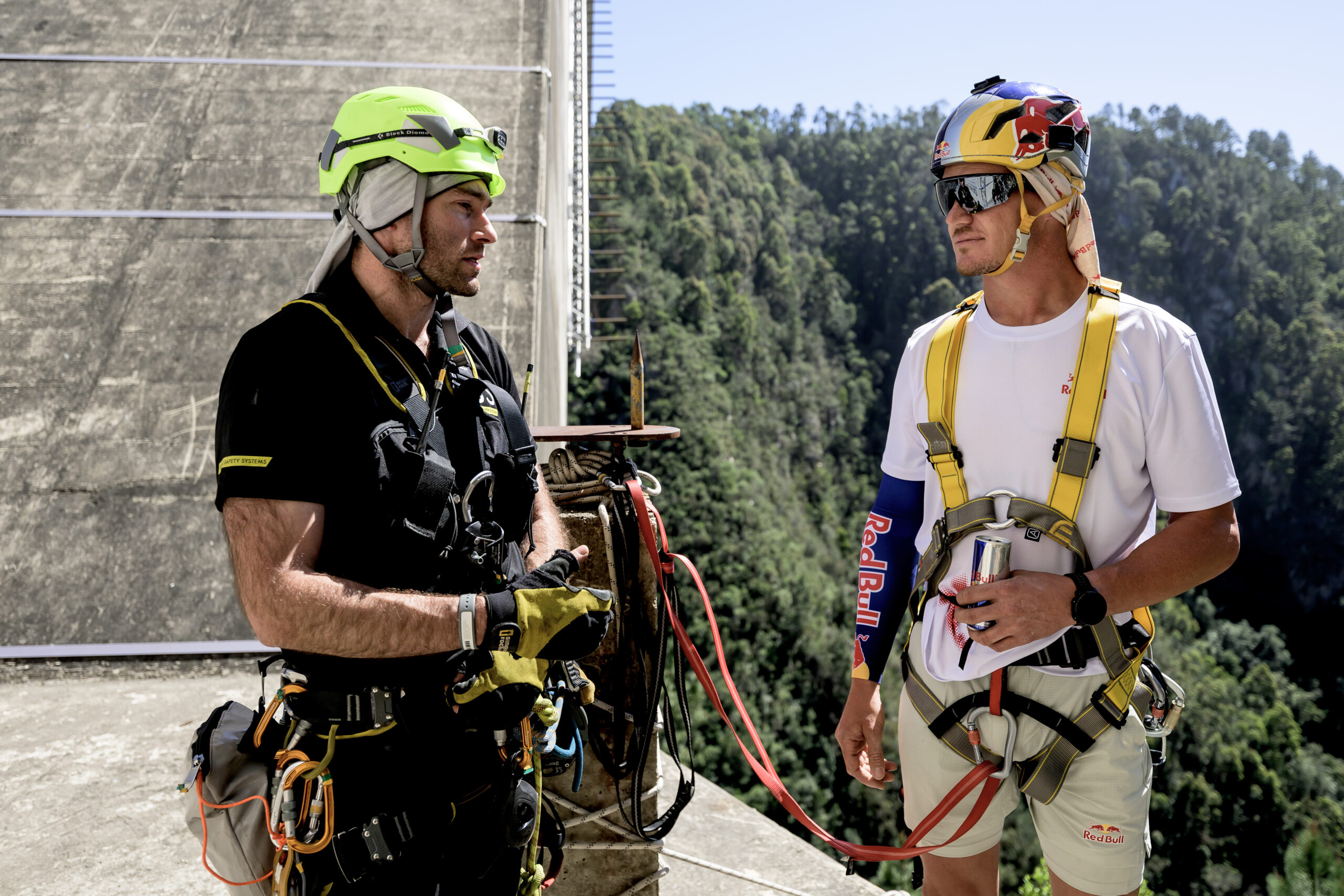
The course has required a bespoke engineering solution. Designed and installed by Cape Town-based Vertical Safety Systems (VSS), the structure follows the arch using individual truss sections secured by straps wrapped around the bridge. No drilling or permanent bolting is needed, allowing the installation to be removed without leaving a trace.
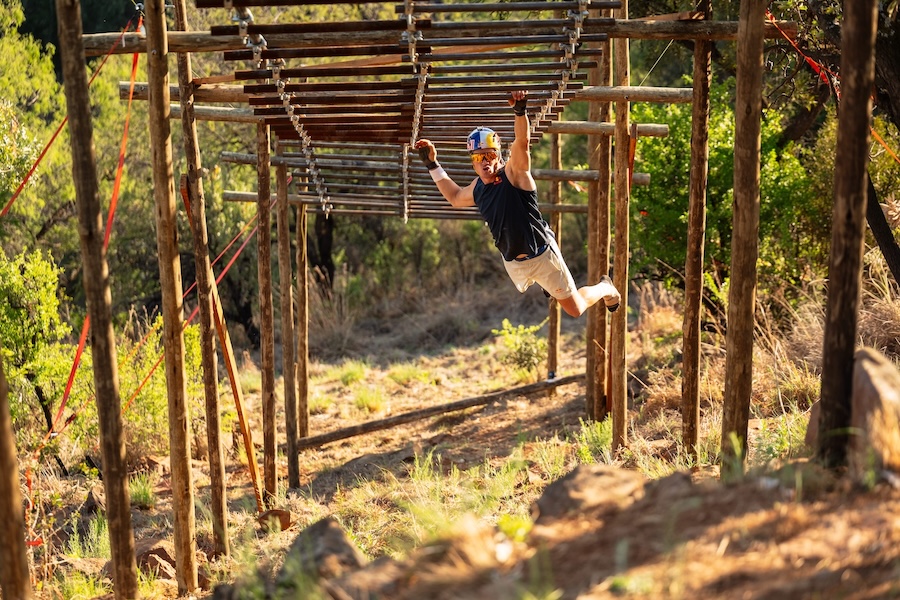
Van Tonder has spent six months preparing for the attempt, training on a purpose-built, approximately 48-metre simulation rig at his home. The full scale of the bridge and its changing gradients, however, present challenges that cannot be replicated in training. Even the transition points between climbing, swinging, and braking will have to be assessed on the structure itself.
The attempt builds on van Tonder’s background in obstacle course racing. He became the 2019 100-metre OCR World Champion, and set a Guinness World Record in 2020 for the fastest 50-metre rope climb, completing it in 3 minutes and 19.68 seconds.
Watch live: Red Bull Bridge Bars will be broadcast on YouTube on October 26 at a tentative 10:00 SAST (= 08:00 UTC), subject to weather conditions and change.
Key Facts
- Athlete: Thomas van Tonder – South Africa – Red Bull athlete
- Challenge: First crossing of 600 monkey bars suspended beneath a bridge
- Attempt weather window: 26-27 October 2026
- Location: Bloukrans Bridge, Garden Route, Eastern Cape, South Africa
- Height above river: 216 m
- Total bridge length: 451 m
- Main arch span: 272 m
- Arch rise: Approximately 62 m
- Monkey-bar course length: 280 m
- Number of monkey bars: 600
- Bar spacing: 0.5 m for 90% of bars, 0.65 m every sixth bar due to construction requirements.
- Bar diameters: 38 mm on the ascent, 48 mm across the middle section, 42 mm on the descent
- Maximum incline and decline: 45°
- Total structure weight: 5,000 kg
- Truss construction: Approximately 100 individual sections, each 3 m long
- Installation method: Straps wrapped around the bridge’s arch, without drilling or permanent fixings
- Preparation period: Six months
- Planned broadcast: YouTube
Exclusive Q&A: The Physical Science Behind the Crossing
Thomas van Tonder, OCR World Champion
Q: The course goes up, across and then down. What does each of the three sections ask of your body that the other two do not?
Thomas van Tonder: I’ve broken the bridge up into three different sections, based on the technique that works best for moving across each one. The first one is the incline. Obviously, the closer you are to the start or finish, the steeper the incline is, and in the middle it’s less.
The initial incline is so steep that I can’t do it facing forward, in what we call the forward swinging position. I literally have to turn my body around facing backwards, pull myself up, and then reach for the next bar.
Each time I reach, the hand that’s not reaching has to lock off in a 90-degree stationary hold while the other hand reaches up to the next bar. This movement is usually fine in small amounts, but the hard part is the sheer number of them I have to do consecutively.
The muscle groups I use get fatigued, and on top of that fatigue, I still need to find a way to keep going. I think the hard part on the incline specifically is the fatigue building up in the same muscle groups, which have to do the same pulling movement over and over to reach the next bar.
The gradient is also extremely difficult, especially at the start. It’s a 45-degree incline, which is really steep. People underestimate it; even I underestimated it. So getting to the next bar is hardest on that first incline section.
There will be a point on the bridge – I’m not sure where – where I can switch to what I’d call the forward swinging motion. The incline gets less there, but it’s still an incline. Ideally, I’d get to a point where I can swing, one hand down and up again, the other hand down and up again, swinging forward like a typical monkey swing, I guess. Usually, this is my most comfortable technique for covering distance on monkey bars.
But the muscle groups I use for this technique have already been obliterated by the climb just to get to that point. So what would usually be easier is now already harder, because the muscles, the forearms, and especially the grip have just done something incredible to get to the starting point of this technique.
The bars are also a bit thicker in this section. The theory, and what I’ve tested, is that once I can start swinging forward, the thicker bar is a bit more forgiving on my hands. A smaller bar, when I’m swinging forward, eats more into my hands. Even though the thicker bar is a bit harder to hold onto, the idea is to get my hands to survive the whole climb. So the thicker bar in the middle section is a bit more forgiving. It’s not much, but a little bit counts.
The middle part would have been the easier part, but it isn’t, because of how fatigued the muscles are by the middle section. It’s also the scariest part, because you’re the highest off the ground. When we tested the middle section, it was mentally really hard to stay composed and not get carried away by how exposed you are, especially since most of the time you’re hanging on a single hand.
Mentally, the middle segment is the hardest part. Looking ahead, seeing the arch and how far you still have to go to the finish is super intimidating. You almost can’t fathom it: all those bars in front of you, and you still have to do every one of them.
Then, once I’ve swung across the middle, it starts becoming a descent. It’s less of a pulling motion and more of a dropping motion. When the drop gets too steep, what we call an eccentric movement comes in. Imagine jumping up onto a bar and lowering yourself slowly.
I now have to catch myself every time I move to the next bar, so I don’t build up too much momentum, go too fast, rip my hands off the bar, and fall. So controlling the way down is almost the hardest part, again because we’ve almost maxed out on the climb and pushed beyond that in the middle. Now we’re using those muscles eccentrically, slow and controlled, which is even harder in its own right on fatigued muscles.
Q: On a flat run of monkey bars, every movement repeats. On the arch, the angle changes under every bar. Is there anywhere on the route where two bars in a row feel the same?
Thomas van Tonder: Yes, the changing angle brings a couple of complexities. First, it made it really hard to train for all the different movements. I can’t just hyper-focus on a single technique. I have to be able to do all of the different techniques, and at a magnitude never seen before. So training has been really hard.
The hard part with the gradient change is that I’ve had no way of knowing at what point on the bridge I’ll be able to use which technique. We’ve guesstimated, or aimed for, where the bar sizes should change. So it’s something I’ll have to test multiple times on the bridge: where does it change, where can I actually go forward?
I might try going forward for a bit, find it doesn’t work, and have to go back to the other technique. The change is gradual, though, so it’s hard in the sense that I can’t know “from this point I can switch.” I almost have to feel it when I get to the point where the technique becomes viable. That puts a lot of extra mental strain on me to figure out what’s best to use at which point, with the fear, obviously, of some muscle groups failing at any moment from overusing a specific technique or movement.
Q: Describe the changeover at the top, where the route stops going up and starts going down. Is there a moment where you stop climbing and start braking?
Thomas van Tonder: I’d guess there’ll be maybe 20 to 30 metres under the top of the arch where I’m neither climbing nor braking. It’ll be a normal monkey bar swing. Everything from the start to that point, I’ll be climbing.
And everything from that point to the finish, I’ll be managing my momentum and then braking, for sure. I explained in the first long voice note how it would usually be easier. But because we’ve gone absolutely to the max just to get to the point where I start braking, it feels really hard, and it really burns, because of how fatigued you are before you even start the braking movement.
Towards the finish, it’s a very steep drop, and it’s quite challenging to force yourself to go slowly enough to actually grab the next bar. If you don’t brake enough, you land too hard on your next hand, and the bar rips out of it, because your hands can barely close. They’re pretty burnt. Burnt or fried. Fatigued.
Q: Name the one thing that could only be learned on the bridge itself.
Thomas van Tonder: For training, the first thing that comes to mind is the continuousness, the sheer scale and size of it. You can’t replicate it anywhere. We built a massive rig on the side of the mountain at my home to train on, and it ended up at just under 50 metres, about 48.
In training, I go up that and then back down again. So the up is only about 50 metres, while on the bridge it’s three times that in a single movement. The up would be three times as long. So I can’t replicate how continuously the same muscle groups get hammered. That’s been really hard to train for.
And the one thing that can only be learned on the bridge is where the transition points will be, and how long I can keep going on that really steep incline. The steep incline and decline are longer than my simulation rig at home. I know I can probably do about 40 to 50 metres in one go, but beyond that I don’t know, because we’ve never done it. We’ll have to see on the bridge.
Exclusive Q&A: Engineering the Course Around the Bridge
Richard Lievaart, Head of Rigging and Safety, Vertical Safety Systems (VSS)
Q: A set of monkey bars is straight; an arch is a curve. How do you hang one from the other – do the bars sit on a series of short straight chords, or does every segment have its own geometry?
Richard Lievaart: Setting up the straight trusses, or straight bars, into the curve of the arch. Each three-metre piece of truss is individually strapped onto the bridge. The truss itself is designed to be attached to four different chords.
In our build, we’re only attaching two of the four chords, which gives the space for the ladder. Each piece of truss is touching, but it’s slightly apart at the top, which gives us the space for the curve. But each truss is still individually strapped onto the bridge.
Every piece of three-metre truss gets its own strap, so essentially we have a hundred individual pieces of trussing. We’re still using the bottom chord of the truss to attach them together to make it even more secure, so they all connect to each other, but that still gives us that slight bit of curve.
Q: Nothing is bolted or drilled into the bridge. How does the system of straps wrapped around the curved concrete keep the rig securely in position, particularly when Thomas is swinging beneath it?
Richard Lievaart: That basically means everything has to be able to be packed away and taken with us, leaving no trace that we were there. So we worked out a cantilever system. The rungs themselves are actually one metre long: 20 centimetres is underneath the bridge, 30 centimetres is strapped underneath the truss, and then 50 centimetres, half a metre, is exposed for Thomas to hang on. With that 20 centimetres underneath the bridge, when Thomas pulls on one side, the lever pulls up into the bridge on the other.
We’re using that counterforce to make the half metre Thomas is hanging on as secure and tight as we can. The straps go all around the bridge, and they’re all about 40 metres long.
They go all the way around the arch, with rope and edge protectors on every single corner to protect the straps, and it’s all ratchet-strapped on. The 20 centimetres that goes under the bridge also means we know it’s snug, secure, and held in place by the straps.
The straps are essentially trying to pull the truss up into the bridge the whole time. And because each truss is also half connected to the next one, the straps end up tying all the trusses to each other.
With all of that together, the only real movement or flex in the system is in the rungs themselves. The half metre sticking out does have a little bit of flex, but other than that, the truss is held securely in position.
Watch Red Bull Bridge Bars live on YouTube on October 26 at a tentative 10:00 SAST (= 08:00 UTC), subject to weather conditions and change.
Images free of charge for editorial use.
Available here: RED BULL CONTENT POOL
Contact: Fabian Ress
fabian.ress@3mpg.ch / +49 173 248 8404