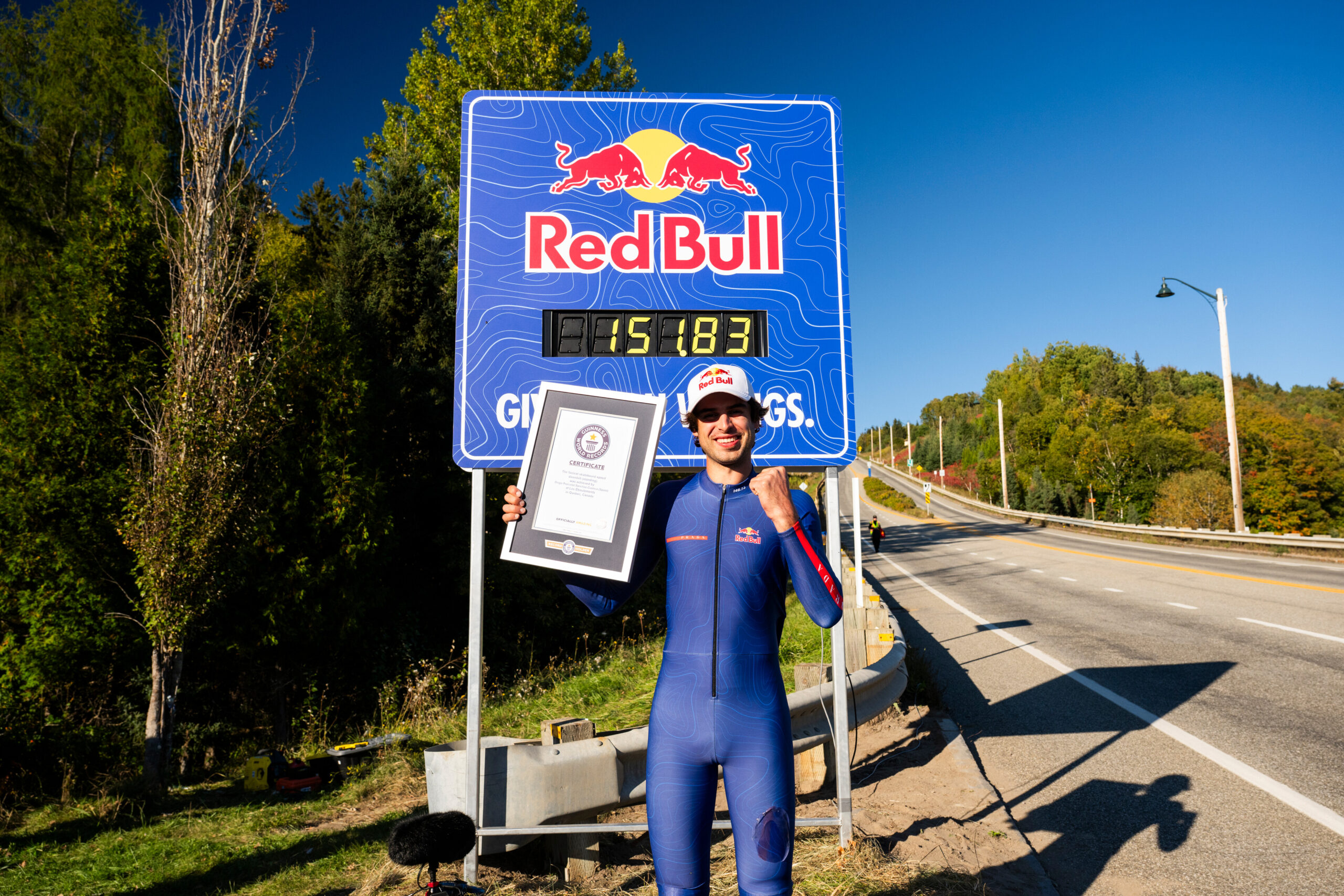
Two-time downhill champion sets a new Guinness World Records™ title, reaching 151.83 km/h (94.34 mph) on a skateboard on a closed road in Les Éboulements, Canada, after years of preparation, engineering and scientific analysis.
Quebec, CANADA, 15 October 2026
Key Facts
- Record: Fastest skateboard speed achieved in a standing position
- Speed: 151.83 km/h (94.34 mph)
- Athlete: Diego Poncelet (Spain), age 27, Red Bull athlete and two-time world downhill skateboarding champion
- Date of the record run: 22 September 2026
- Location: A closed section of Route du Port, Les Éboulements, Charlevoix region, Quebec, Canada
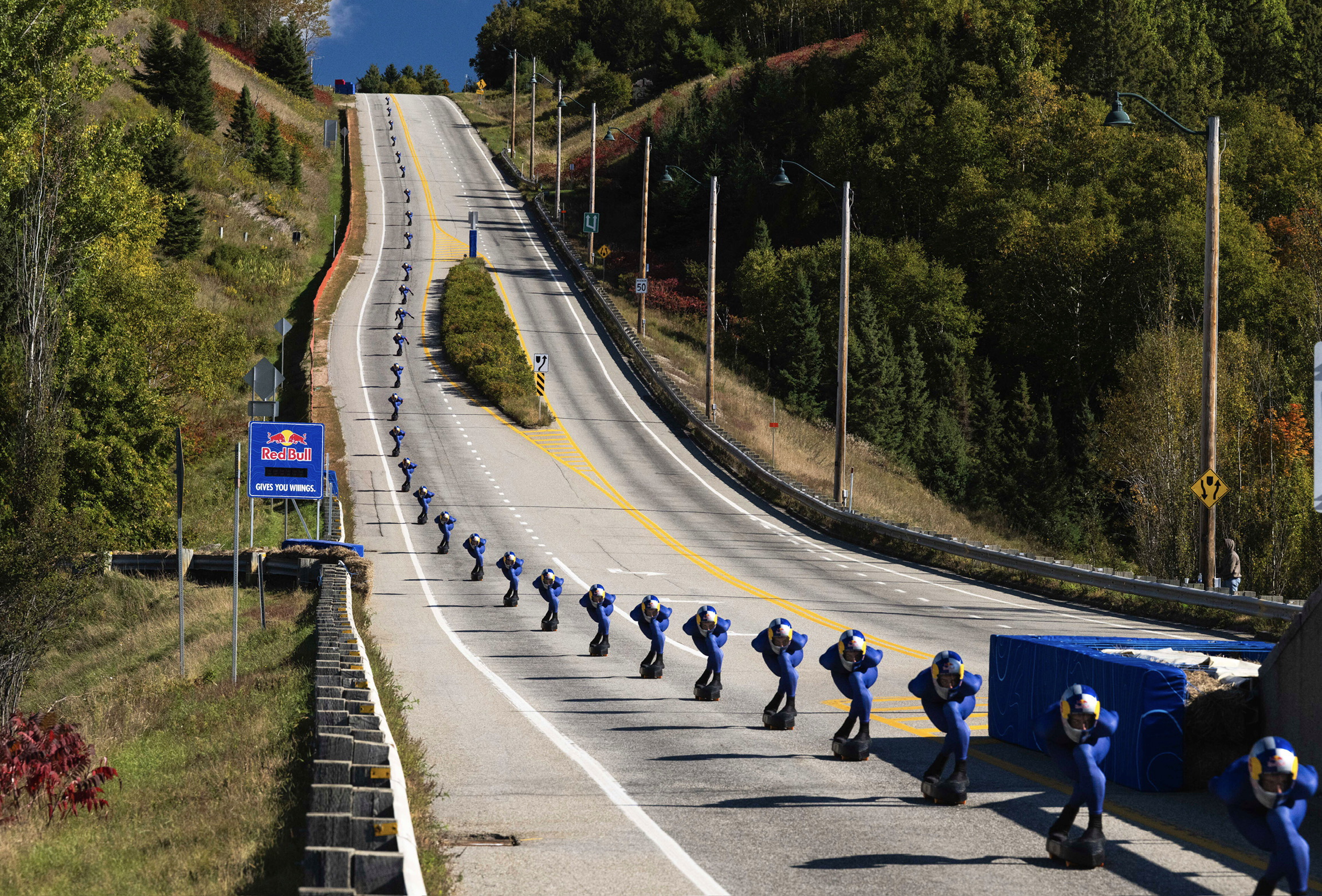
- Road profile: 18% decline at its peak, sustained over a 600m straight line, around 2.2km in length
- Ratification: Set in the presence of a Guinness World Records™ adjudicator
- First run of the project: 146.88 km/h, achieved on the first day of testing, already past the existing record
- Previous record: 146.73 km/h (91.17 mph) by Pete Connolly in 2017, set on the same hill
- Conditions for the record run: 10 to 14 km/h of tailwind from the northeast during a short window as the wind was turning
- Wait for conditions: Five further days after the first day of testing before the wind allowed a second attempt
- Equipment: Signature 9.81 Skateboards pro model, Seismic wheels, bearings and grip tape, encased in a custom aerodynamic carbon-fibre fairing
- Official partners involved: Prada Linea Rossa (footwear and gloves), Porsche (Official Automotive Partner, Porsche 911 chase car and Porsche Cayenne Electric safety car)
- Key team members: Martin Siegrist (aerodynamics and 3D-modelled fairings), Grégoire Schab (chase car driver), Miguel Sánchez Cuenca (meteorologist)
- Why it matters: The achievement fulfills a lifelong dream for Poncelet, cementing his position as a pioneer in the sport, and stands as a tribute to Pete Connolly, who set the original record on the same hill and died from illness in 2025
- Availability: Full editorial asset package on Red Bull Content Pool, including photos, news cuts, social news cuts, interview selects, press releases, social news clips in English, Spanish and French, action clips, infographics, shotlist and transcript
Headline points
- Two-time downhill champion sets a new Guinness World Records™ title, reaching 151.83km/h (94.34mph) on a skateboard
- Years of preparation, engineering and scientific analysis enable history to be made
- Wind tunnel training, working with meteorologists, physical fitness, and bespoke performance wear from Prada Linea Rossa, just some of the tools to succeed in this technical sporting advancement
- The achievement fulfills a lifelong dream for Poncelet, cementing his position as a pioneer in the sport
- The record-breaking run took place on a closed road in Les Éboulements, in the Charlevoix region of Canada, home to the previous world record
What Diego Poncelet achieved on Route du Port
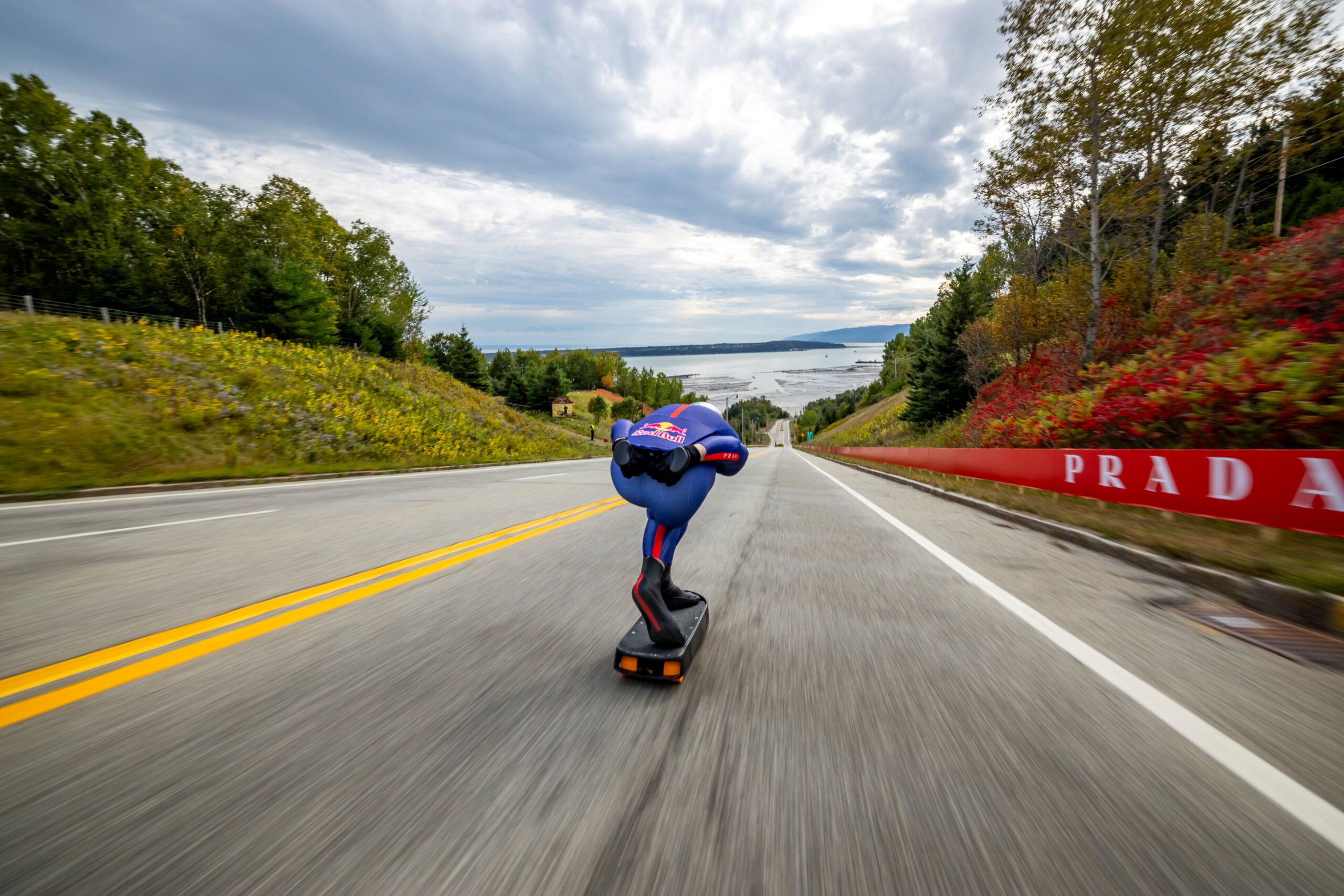
Red Bull athlete Diego Poncelet has become the fastest skateboarder in history, reaching 151.83 km/h (94.34 mph) – achieving the Guinness World Records™ title for the fastest skateboard speed achieved in a standing position.
Incredibly, the 27-year-old Spaniard managed to break the record by a small margin on his first day of testing. Assessing conditions, Poncelet knew there was potential for more – but with wind speeds far from ideal, he was forced to wait another five days for the perfect conditions. He then made history once again, smashing the record further, setting a new benchmark for the sport.
“I never truly admitted to myself that my real objective was to get to 150km/h – I was scared that it wouldn’t be doable,” Diego said following the attempt. “But I realized that I couldn’t lie to myself – at 146.88km/h, I wasn’t satisfied yet. It was only when I got that 151k/h that I was completely ecstatic.”
Diego’s obsession with speed started young – before he found the world of downhill skating, his ambitions to become a Formula One driver merged with his passion for the rebel culture of skateboarding. When asked what drove his obsession to reach 150km/h, he said: “What will it feel like? That was the main drive, the search for a feeling no one had known before. I was convinced that experience could only happen if I reached into the 150’s.”
The feat took place in mid-September on a closed section of Route du Port in Les Éboulements, in the Charlevoix region of Canada, in the presence of a Guinness World Records™ adjudicator.
How Poncelet combined instinct, science and skill
Poncelet’s record-breaking descent goes far beyond sheer nerve – it was a childhood dream, made real by years of work, research, training, and skill.
Sessions in a Geneva wind tunnel refined his posture and established how long he could hold his position before his body started to give. Physically, he set out to be as heavy and as lean as possible while staying streamlined. He improved the mobility of his torso and trained his neck to bend until it touched his knee – shaping his body like a wing to maximise aerodynamic efficiency.
At full speed, Poncelet can barely move without risking instability on the board. He relies on subtle body movements to work with the airflow – crouching to accelerate, standing to slow down. Unable to see clearly ahead from his compact position, he navigates using his memory of the road and the painted white lines. Every corner is memorised in advance and ridden on instinct, because at high speeds a corner arrives before a conscious decision can be made.
How the suit, the Prada Linea Rossa footwear and the board were engineered for speed
Every element of Poncelet’s set-up was selected for speed and performance. His suit uses textured fabrics that help the air hug his body instead of breaking away behind him, shrinking the turbulent wake that causes most drag. Additionally, they introduced a spoiler technology on his back so as to tuck his hands underneath and give the air a clean break away point.
Official partner Prada Linea Rossa worked with Poncelet to design and develop his footwear and gloves. The seamless 3D knit aerodynamic shoes included an asymmetrical design that maximised stability on the front while minimising air resistance on the rear. An inner sole made with d3o technology helped dampen the vibrations of the road and an integrated rubber sole both lowered his position and kept him gripped to his board. The optimized gloves and pucks provided a clean cut-off point for the wind while ensuring he could put his hands on the ground to drift in case of an emergency.
At the heart of the attempt was Diego’s signature 9.81 Skateboards pro model, a board he had ridden on roads around the world. Fitted with Seismic wheels, bearings and grip tape, it was encased in a custom aerodynamic carbon-fibre fairing for the record attempt.
How the Charlevoix road in Les Éboulements was chosen
Finding the right road was a crucial part of the process. Poncelet spent years searching for and testing potential locations, from Austria and Ireland to Canada, assessing each road for its gradient, surface, length and conditions.
“I’ve spent countless nights looking at maps trying to find something better, especially when I was told that it was too damaged and consequently did not see it as an option,” said Diego. “I went crazy trying different roads, but at some point realized that it could not be beat. There’s no other road in the world like it, so I went to check it out and see if it could still be ridden.” The road has, at its peak, an 18% decline sustained over a straight-line of 600m, and is around 2.2km in length.
The team and the weather window behind the record
Poncelet was surrounded by a group of friends, family and mentors to help him achieve his dream. Industrial engineer and former world champion skater Martin Siegrist analysed Diego’s position and designed 3D-modelled aerodynamic fairings to reduce air resistance. Friend and fellow rider, Grégoire Schab, drove the Porsche 911 chase car to document the feat. At such high speeds, precision driving becomes as important as the rider’s performance itself. As Official Automotive Partner, Porsche supplied both the Porsche 911 and the Porsche Cayenne Electric safety car, training drivers ensuring the highest level of accuracy and control during the attempt.
Grégoire said: “Following Diego at these speeds, it’s super scary. As a skater myself, when I see this beast of a road, the steepness is intimidating because as soon as you drop, there’s no breaking, so you have to go all the way through. It’s a total send.”
Only the wind was outside of the team’s control. Reading the weather conditions fell to Miguel Sánchez Cuenca, Poncelet’s meteorologist uncle who works at the elite levels of America’s Cup sailing.
“The Charlevoix road sits in a valley alongside the St. Lawrence River estuary, which causes wind to funnel in a very particular way,” Sánchez Cuenca commented. “There is a general tendency of southwestern winds, which is the opposite of the tailwind needed for Diego to achieve his goal, and while headwinds slow you down, crosswinds can be even worse as they cause unpredictability and instability. The wind was one of the most important parts of the project, and finding the right window was a difficult process. For the 151.83 km/h run, we had 10–14 km/h of tailwind from the northeast during a short window as the wind was turning, which we managed to take advantage of at the perfect angle.”
Why the record is a tribute to Pete Connolly
Throughout his career Poncelet has long been inspired by his friend, the British downhill skateboarder, Pete Connolly, who set the original world record on the same hill in 2017. Connolly was one of the very few people who believed 150 km/h was reachable at all – he encouraged Poncelet to go after the number, and the hill, that he had made his own. Connolly passed away from illness in 2025; the project has been a tribute to him since.
With his new record, Poncelet has drawn a new line for how fast the sport can go – no longer the “crazy kid” of the discipline, but the rider who found his way past a barrier many thought was impossible.
Quotes
Diego Poncelet – Red Bull athlete, two-time world downhill skateboarding champion and Guinness World Records™ title holder
“I never truly admitted to myself that my real objective was to get to 150km/h – I was scared that it wouldn’t be doable. But I realized that I couldn’t lie to myself – at 146.88km/h, I wasn’t satisfied yet. It was only when I got that 151k/h that I was completely ecstatic.”
On what drove the obsession with 150 km/h: “What will it feel like? That was the main drive, the search for a feeling no one had known before. I was convinced that experience could only happen if I reached into the 150’s.”
On finding the road: “I’ve spent countless nights looking at maps trying to find something better, especially when I was told that it was too damaged and consequently did not see it as an option. I went crazy trying different roads, but at some point realized that it could not be beat. There’s no other road in the world like it, so I went to check it out and see if it could still be ridden.”
Grégoire Schab – rider and Porsche 911 chase car driver
“Following Diego at these speeds, it’s super scary. As a skater myself, when I see this beast of a road, the steepness is intimidating because as soon as you drop, there’s no breaking, so you have to go all the way through. It’s a total send.”
Miguel Sánchez Cuenca – meteorologist
“The Charlevoix road sits in a valley alongside the St. Lawrence River estuary, which causes wind to funnel in a very particular way. There is a general tendency of southwestern winds, which is the opposite of the tailwind needed for Diego to achieve his goal, and while headwinds slow you down, crosswinds can be even worse as they cause unpredictability and instability. The wind was one of the most important parts of the project, and finding the right window was a difficult process. For the 151.83 km/h run, we had 10–14 km/h of tailwind from the northeast during a short window as the wind was turning, which we managed to take advantage of at the perfect angle.”
About Diego Poncelet
Diego Poncelet is a two-time world downhill skateboarding champion and one of the sport’s most accomplished athletes. Renowned for his precise, technical riding style and relentless pursuit of speed, Poncelet has helped redefine the limits of downhill skateboarding and inspire a new generation of riders.
Born in Mexico and raised in Spain and Switzerland by a Spanish mother and Belgian father, the 27-year-old has built a reputation as one of the fastest and most innovative figures in downhill skateboarding, pushing the sport forward through ambitious projects that challenge the limits of human performance and velocity.
About the team around the attempt
Martin Siegrist is an industrial engineer and former world champion skater. He analysed Diego’s position and designed the 3D-modelled aerodynamic fairings that reduced air resistance.
Grégoire Schab is a friend and fellow rider. He drove the Porsche 911 chase car to document the feat, at speeds where precision driving becomes as important as the rider’s performance itself.
Miguel Sánchez Cuenca is Poncelet’s uncle and the project’s meteorologist. He works at the elite levels of America’s Cup sailing, and read the wind conditions in the Charlevoix valley to find the record window.
Pete Connolly was a British downhill skateboarder and Poncelet’s friend. He set the original world record of 146.73 km/h (91.17 mph) on the same hill in 2017, was one of the very few people who believed 150 km/h was reachable, and encouraged Poncelet to go after it. He passed away from illness in 2025.
About the partners
Prada Linea Rossa, official partner, worked with Poncelet to design and develop his footwear and gloves, including seamless 3D knit aerodynamic shoes with an asymmetrical design, an inner sole made with d3o technology, and optimized gloves and pucks.
Porsche, Official Automotive Partner, supplied the Porsche 911 chase car and the Porsche Cayenne Electric safety car, and trained drivers to ensure the highest level of accuracy and control during the attempt.
9.81 Skateboards produced Diego’s signature pro model, the board at the heart of the attempt, fitted with Seismic wheels, bearings and grip tape and encased in a custom aerodynamic carbon-fibre fairing.
Fact sheet
- The record: The fastest skateboard speed achieved in a standing position is 151.83 km/h (94.34 mph) by Diego Poncelet (Spain), at Les Éboulements in Quebec, Canada, on 22 September 2026.
- The previous record: Pete Connolly achieved a speed of 146.73 km/h (91.17 mph) in 2017, on the same hill.
- The margin: Poncelet passed the existing record on his first day of testing with 146.88 km/h, then waited five more days for wind conditions before setting 151.83 km/h.
- The road: A closed section of Route du Port in Les Éboulements, Charlevoix region, Quebec, Canada. At its peak an 18% decline sustained over a 600m straight line, and around 2.2km in length. Poncelet spent years assessing roads in Austria, Ireland and Canada before returning to this one.
- The conditions: 10 to 14 km/h of tailwind from the northeast during a short window as the wind was turning. Southwestern winds are the general tendency in the valley, the opposite of what the attempt needed.
- The preparation: Wind tunnel sessions in Geneva to refine posture and hold time, a physical programme to be as heavy and lean as possible while staying streamlined, improved torso mobility, and neck training to bend until it touched his knee.
- The riding: At full speed Poncelet relies on subtle body movements, crouching to accelerate and standing to slow down, navigating by memory of the road and the painted white lines because he cannot see clearly ahead from his compact position.
- The equipment: A suit in textured fabrics with spoiler technology on the back, Prada Linea Rossa 3D knit shoes with a d3o inner sole and integrated rubber sole, optimized Prada Linea Rossa gloves and pucks, and a signature 9.81 Skateboards pro model with Seismic wheels, bearings and grip tape inside a custom carbon-fibre fairing.
- The team: Martin Siegrist on aerodynamics and fairings, Grégoire Schab driving the Porsche 911 chase car, Miguel Sánchez Cuenca on meteorology.
- The tribute: The project has been a tribute to Pete Connolly since his death from illness in 2025.
- Ratification: Set in the presence of a Guinness World Records™ adjudicator.
More Information
Watch Diego Poncelet’s record-breaking journey at YOUTUBE, and read more at REDBULL.COM
For images and video, visit RED BULL CONTENT POOL
(free content for editorial use, no restrictions)
- News Cut 16:9
- Social News Cut 9:16
- Interview Selects 16:9
- Social News Clip 9:16 CLEAN
- Social News Clip 9:16 with ENG text-on-screen
- Social News Clip 9:16 with ESP text-on-screen
- Social News Clip 9:16 with FRA text-on-screen
- Social News Clip 9:16 with NEUTRAL ENG text-on-screen
- Action Clip 16:9
- Action Clip 9:16
- Photos
- Press Release
- Infographics ENG & ESP
- Shotlist and transcript
Free Download: RED BULL CONTENT POOL
Contact: Fabian Ress
fabian.ress@3mpg.ch, +49 173 248 8404
Images free of charge for editorial use. Credit: Red Bull Content Pool